
If you’ve been stuck in a negative thought loop — the kind that circles regardless of how much you reason with it — you’re not doing it wrong.
You’re simply discovering that the negative thought loop isn’t a logic puzzle; it’s a reflex.
The Secret Commentary Running Beneath Your Conscious Life
In the 1960s, psychiatrist Aaron Beck noticed that his patients were running two streams of thought simultaneously. The first was the conscious conversation — memories, feelings, the topics they were consciously discussing. The second was a rapid, automatic commentary running beneath the surface. These “automatic negative thoughts” (ANTs) arrived unannounced and carried the weight of absolute facts: You’re boring. Nobody actually cares.
Beck called them automatic negative thoughts. His patients didn’t generate these thoughts deliberately — they didn’t decide to think them. They simply arrived, and then by their presence influenced everything else.
The breakthrough wasn’t just identifying these thoughts, but realizing that telling patients they were irrational didn’t make them stop. You cannot think your way out of a thinking problem with logic alone. The loop isn’t running on logic—and it doesn’t respond to it.
Why the Negative Thought Loop Runs Without Your Permission
The negative thought loop has deep evolutionary roots — and understanding those roots changes how you approach interrupting it.
Negativity bias — the brain’s tendency to register, encode, and retrieve negative information more readily than positive — is not a malfunction. It’s the cognitive inheritance. Evolution favored organisms that treated rustling in the bushes as a predator rather than the wind. The consequence is that your threat-detection system is calibrated for an environment that no longer exists.
Today, your brain misclassifies social, professional, and relational friction as life-threatening danger. An unanswered message or a critical colleague activates the same cascade of stress that once handled physical predators. Your nervous system is essentially a Victorian ghost trying to survive in a world of Slack notifications—it’s looking for a saber-toothed tiger in a performance review.
Psychologist Emma Seppälä observed that bad is stronger than good as far as the mind is concerned — our propensity toward negativity is strong enough to produce a structurally skewed reading of reality. That skew intensifies under stress, fatigue, or sustained difficulty: precisely the conditions under which the loop is most active and most damaging.
Why Logic Fails to Stop the Loop Cold
When you try to disprove a negative thought, you’re engaging the analytical brain in a conversation with a system that doesn’t speak logic. The automatic thought is a pattern of neural activation rooted in emotional memory, often firing before you’re even consciously aware of it.
By the time you start arguing, the emotional state is already active; your logic has arrived late to a party that’s been going for several seconds.
Furthermore, “thought suppression”—the internal command to stop thinking about it—actually increases the frequency of the negative thought. This is the “white bear” problem: people asked not to think of a white bear think of white bears constantly. The effort of suppression keeps the thought activated.
Psychologist John Arden identified the neurological mechanism: the more you do something, the more likely you are to do it again. Neurons that fire together wire together. The more you engage with the negative thought — even to argue against it — the more you reinforce the neural pathway that produces it.
What the Negative Thought Loop Is Really Running On
The negative thought loop runs on emotional memory, neural habit, and the threat-detection system’s pattern-matching function — not on the logical content of the thoughts themselves.
Beck’s original insight was that automatic negative thoughts are irrational beliefs we unknowingly reinforce over time. The reinforcement mechanism is the key part. Every time a thought arrives and you react to it — with distress, with counter-argument, with attempts at suppression — you’re reinforcing the pattern.
The activation strengthens the pathway. The pathway makes the next activation easier.
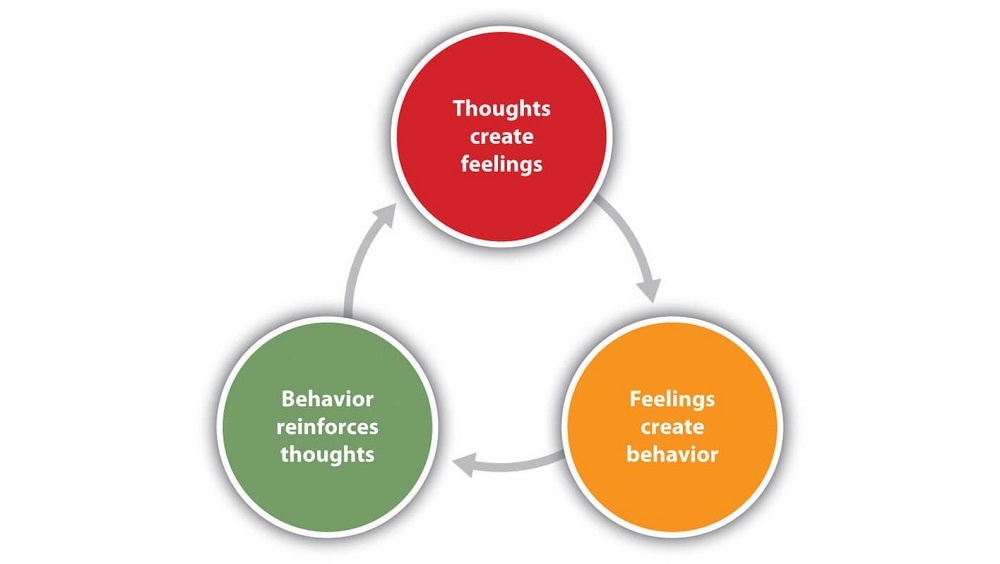
This is the structural reason the loop is self-perpetuating. It’s not that negative thoughts are inherently hard to stop. It’s that the strategies most people use to stop them — trying harder not to have them, arguing against them, berating themselves for having them — are themselves forms of engagement that keep the pathway lit.
Harvard psychologists Killingsworth and Gilbert found that people spend roughly 47% of their waking hours thinking about something other than what they’re currently doing — and that a wandering mind is reliably an unhappy one. The wandering pulls toward the negative, not because the negative is accurate but because the threat-detection system is more activated by negative content.
It’s patrolling, not reporting. The negative thought loop isn’t a bug in your thinking. It’s the threat-detection system doing its job in an environment that has almost nothing real to detect — so it generates its own material.
What Actually Breaks the Negative Thought Loop’s Hold
The most effective way to break the loop’s hold is to change your relationship with the thought rather than its content.
Mindfulness — specifically the practice of observing thoughts — works not because it’s “peaceful,” but because it creates a slight separation between the thinker and the thought. Not “this thought is wrong” but “I’m having this thought right now.”
This distinction activates different circuits than full identification. You are watching the pattern rather than running it.
The goal is not to achieve a state without negative thoughts. Minds generate thoughts compulsively and will continue to do so regardless of instruction. The goal is to change how you relate to the thought — to encounter it with less reactivity, less full identification, less of the emotional engagement that constitutes reinforcement.
Over time, with consistent practice, the pathway that produces the most habitual negative thoughts loses some of its automatic authority. It doesn’t disappear. It becomes less commanding.
Reframing is useful when it’s genuine rather than forced. The CBT instruction isn’t to replace “I always fail” with “I always succeed.” It’s to find the more accurate, more textured version: “I’ve failed at this specific thing before. I’ve also succeeded at other things. What’s actually true here?”
This works not because it’s more logical, but because it provides the emotional memory system with competing evidence. Repeated often enough, the competing evidence changes what the system retrieves by default. Both approaches share the same underlying principle: change what the brain does with the thought rather than trying to prevent the thought from arriving.
The External Conditions That Feed the Loop Quietly
The negative thought loop is not purely internal. It is also fueled by external conditions. Social comparison—holding your internal mess against someone else’s curated external performance—is a fight your negativity bias will lose every time.
Every encounter with apparent evidence of someone else’s success, contentment, or capability delivers fresh material for the negative thought to work with.
The people around you shape the loop through emotional contagion — emotional states transferring between people through subtle social signals, tone, and body language, all before conscious awareness. Time spent with chronically negative or critical people activates threat-detection and feeds the loop.
This isn’t an argument for cutting people off over their disposition. It’s an acknowledgement that your internal environment is partly determined by your external one.
Sleep, physical activity, and nutritional state all affect the loop’s intensity through their direct impact on the prefrontal cortex. A sleep-deprived prefrontal cortex loses the capacity to observe the loop from a distance — it gets pulled in. The negative thought becomes more consuming, less manageable, and more capable of generating that feeling of objective truth that makes it most destructive.
None of these interventions stop the loop by addressing its logical content. All of them change the conditions under which the loop runs. You can’t think your way out, but you can change the terrain.
Building the Capacity to Observe Without Being Consumed
The capacity to observe the negative thought loop without being run by it is not an attitude. It’s a skill. And like all skills, it’s built through repetition rather than understanding.
Understanding the mechanisms here is useful — it changes the frame and removes some of the shame attached to having a mind that circles. But the actual work is the daily practice of noticing the loop, creating the small moment of separation (“I’m having this thought”), and returning to the present without having engaged with the loop’s content as though it were news.
This will feel hollow the first fifty times. That’s expected. The pathway that produces the negative thought has been reinforced over years. The pathway that observes it calmly is new — and new pathways are weak until they’re not.
The same mechanism that built the loop can, through different repetition, gradually shift where the brain goes by default when a negative thought arrives. Not to silence. Not to an absence of difficulty. To a slightly different response to difficulty — one that doesn’t immediately amplify what was already painful.
That’s what the practice builds.
The goal is not the end of the loop, but the end of the loop’s power to run your day.