Most of what we do in life comes with relatively quick confirmation. You send an email; you get a reply. You make a sale; you see the number. You go to the gym, and you feel the soreness.
The feedback is imperfect but present — you have some signal about whether the effort is connecting.
Building anything meaningful is different. The feedback loop is broken or at least delayed — sometimes by months, sometimes by years. You’re putting work into something that gives you almost nothing back in the short term.
No confirmation. No signal. Just the work, and the absence of obvious progress, and the growing suspicion that you might be misreading the entire situation.
Trust the process is the thing you have to hold onto in that gap.
And holding onto it is genuinely hard. Not because you lack discipline or belief — because the human nervous system was not designed for it.
Why the Waiting Is Neurologically Uncomfortable
Your brain is a prediction machine, and it evaluates current behavior against expected return.
When the return doesn’t come — when the work doesn’t seem to be producing results on any timeline your nervous system considers reasonable — the brain starts running threat assessments.
Is this the right direction? Is the effort being misallocated? Is the whole endeavor a mistake?
This isn’t weakness. It’s the threat-detection system doing its job. The system is calibrated for the ancestral environment, where sustained effort without return typically indicated a real problem. The brain doesn’t know you’re building something that compounds on a two-year timeline.
The Stoic philosophers built an entire practice around this exact problem.
Epictetus identified what he called the “dichotomy of control”—the fundamental distinction between what is within your power and what isn’t.
Within your power: your actions, your responses, your quality of work, your consistency. Outside your power: timing, reception, circumstances, other people’s decisions, the specific shape of the outcome.
Most anxiety about progress is anxiety about the second category masquerading as concern about the first. You can’t control when the work pays off. You can control whether you keep doing it.
Trust the process is, at its core, the decision to direct your energy exclusively toward the category where it has leverage — and to stop spending it on the category where it doesn’t. This invisible accumulation is the core of personal growth and the case for getting just one percent better every day.
Marcus Aurelius ran an empire and wrote private notes to himself every day reminding him of this. “Waste no more time arguing about what a good man should be. Be one.” Not: Wait until conditions confirm that being a good man is worth it. Be one, now, regardless of what the feedback loop is offering.
The Dish You’re Holding
Jesse Itzler spent time at a monastery and was assigned to wash dishes. As he worked, a monk kept adding more dirty dishes. Itzler, looking at the growing pile, asked how many he still had to do.
“You only have to do one,” the monk said. “Just the one you’re holding in your hand.”
This is not a productivity tip. It’s a description of the only relationship with work that makes trust the process sustainable.

When you’re looking at the whole pile — at the gap between where you are and where you’re trying to get — you’re working against an imaginary obstacle. The pile is a mental construction. The dish in your hand is real.
The pile can’t be washed. The dish can.
The mind naturally projects forward—cataloging everything that remains undone, calculating the distance to the destination, and running scenarios about whether the destination is even reachable. This projection is almost entirely useless in the context of building something. The future can’t be worked on. The present task can.
Trust the process operationally means closing the gap between where you’re directing your attention and where the actual work is.
Not thinking about the outcome while you do the work. Not calculating how far you’ve come or how far you have to go. Just the dish in your hand, done as well as it can be done, and then the next one.
By staying locked in to the constraints of your chosen path, you eventually find the freedom the process promised.
What the Stoics Understood About Feedback
The Stoics had a concept they called “amor fati”—love of fate. Not resigned acceptance of whatever happens. Active embrace of it. The willingness to find in every outcome — success, failure, delay, or unexpected obstacle — something useful.
This applies directly to the experience of working without confirmation.
The period where trust the process is hardest — where you’re working consistently, seeing no results, and questioning everything — is also the period where the most important adaptation happens. Not the external progress. The internal one.
This is where you find out whether the work is something you’re actually willing to do or just something you wanted the outcome of. This is where habits solidify or collapse. This is where the relationship between your self-concept and your behavior either updates or reverts.
The feedback loop isn’t broken. It’s just not returning the signal you were expecting.
What it’s returning is harder to see and more valuable: evidence about who you actually are under conditions that offer no reward. Evidence about the quality of your consistency, your relationship with difficulty, and your capacity for sustained effort without applause.
That evidence, accumulated over the period where trust the process feels like self-delusion, is the actual product.
The visible result, when it comes, is just the receipt.
When the Process Deserves Examination
Trust the process is not an instruction to persist with something broken indefinitely.
There is a version of “trust the process” that is actually “avoid the discomfort of changing direction.” That’s not trust — that’s avoidance wearing a stoic face.
The useful distinction: Are you questioning the process because there’s genuine evidence it isn’t working, or because you’re impatient with a timeline that’s longer than you wanted?
Evidence it isn’t working looks like the approach is structurally flawed, the feedback you’re getting (even the limited feedback available) is consistently negative, you’ve tried adjusting and the adjustment hasn’t helped, and independent assessment suggests the direction is wrong.
Impatience looks like: it’s been longer than you expected, it’s uncomfortable, nothing seems to be changing, and you can’t see the progress yet.
The first warrants examination. The second warrants continuing.
Seneca wrote that in times of security, the spirit should be preparing itself for difficult times. The inverse is also true: in difficult times, you examine whether the difficulty is productive or structural — and then you choose accordingly.
Trust the process is not blind faith. It’s the reasoned decision, made on the best available evidence, to keep going — because the absence of visible progress is not the same as the absence of progress, and the discomfort of waiting is not the same as a signal that something is wrong.
Why Nothingness is Actually Structural Consolidation
The reason the “middle” of a process feels so agonizing is that we expect progress to be linear—a direct 1:1 relationship between effort and result. But in almost every complex human endeavor, progress follows a different architecture: the Plateau of Latent Potential.
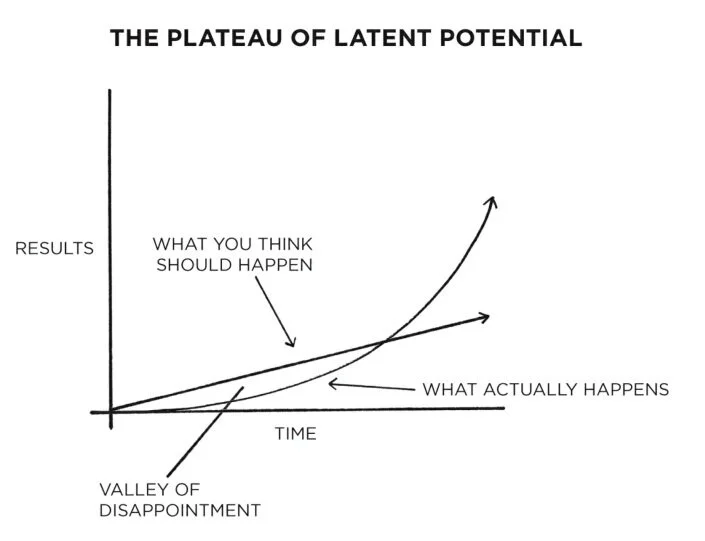
Photo by James Clear
When you feel like nothing is happening, your brain is actually engaged in structural consolidation. You are currently automating sub-skills, building neural efficiency, and creating the biological capacity to handle the eventual result.
Think of it like building a skyscraper: for months, all the work happens underground in the foundation. From the street level, it looks like a hole in the ground where nothing is happening.
But without that invisible, “useless” phase, the structure would collapse the moment it started to gain height. “Trusting the process” is simply the recognition that the foundation is currently being poured, even if you can’t see the view from the top floor yet.
The Work That Looks Like Nothing
The most productive periods of any significant endeavor are often the ones that look, from the outside, like nothing is happening.
The compound that hasn’t paid yet. The skill that hasn’t expressed itself visibly. The relationship that hasn’t produced the outcome but is being built with every interaction. The habit that hasn’t become automatic but is being reinforced with every repetition.
This is the process. Not the dramatic moment of breakthrough, not the achievement that validates the effort, and not the feedback that confirms the direction — the invisible accumulation of consistent action in the absence of confirmation.
Trust it.
Not because it always works. Not because the outcome is guaranteed. But because the alternative — abandoning every process the moment it stops providing immediate feedback — guarantees you’ll never build anything that takes longer than a week.
The dish is in your hand.
Wash it.