
Relaxation Becomes One More Appointment
The day fills with small repairs. There is a breathing exercise on the bus, a cold rinse at the end of the shower, and a ten-minute reset sitting on the calendar at three. Each one is reasonable, and none of them looks excessive on its own. Together, they can start to look like a second job.
By afternoon, the checking has become a reflex, and it rarely feels like checking at all. You glance at the stress reading, then at your heart rate, then at the app that logs your mood in three colors. Somewhere along the way, you stop asking how you feel and start asking what the data says about it.
Even relaxing begins to feel like a performance. You lie on the couch and wonder whether this counts as recovery or whether you are doing it wrong. A habit built to ease the day has quietly become part of its workload.
This is the odd shift underneath it all. Calm used to be what arrived after a good day, a side effect of living well rather than a goal in itself. Now it is a task with a streak counter attached.
Nobody announced the change, yet many people know what it feels like to be off duty and still on the clock. From the outside, none of this looks like a problem. The routines are healthy, the intentions are good, and the data proves that effort was made.
That is exactly why it can be hard to notice when rest has quietly become work.
How Rest Became a Product Category
For years, wellness taught us to track everything from steps and sleep to glucose and recovery. Now, the same market is selling nervous system regulation as a way to recover from the pressure of constant improvement.
The Global Wellness Summit’s 2026 trends report identified an “Over-Optimization Backlash.” The phrase captures a growing tension: people want relief from the demands of modern life, yet the solutions often arrive with more things to do.
Hotels offer nervous system reset programs. Wearables report stress and recovery scores. Studio classes promise to calm the body in an hour. None of these offerings is necessarily foolish, and many can be genuinely useful. The trouble lies in the frame they share.
Once rest becomes a product, it can always be improved, upgraded, or sold again.
That frame also shapes how you understand exhaustion. A rushed year, an overflowing inbox, and a phone that never stops buzzing can fade into the background. The problem becomes the nervous system, which you are invited to fix with the right device, class, or breathing pattern.
The environment remains much the same, but the responsibility shifts toward the individual. If you still feel tired, perhaps you haven’t managed yourself well enough.
Even the language has changed. Terms such as dysregulation have moved into everyday wellness talk, sometimes sounding less like descriptions and more like personal assessments. Exhaustion starts to feel like a private shortfall rather than a reasonable response to a demanding life.
There is nothing wrong with wanting to feel better. It becomes a different matter when every answer asks for more work on ourselves.
Why Watching Calm Keeps It Away
Think about trying to fall asleep when you have somewhere important to be the next morning. You check the time, calculate how many hours remain, and tell yourself to stop worrying. Then you wonder why you’re still awake.
The effort to control the problem has become part of the problem.
A similar loop can develop with stress tracking. Your wearable reports a high reading, and you worry about what it means. That worry makes it harder to settle, so the next reading feels even more important. The device records another number, and you have fresh evidence that something might be wrong.
The number itself is rarely the trouble. The meaning attached to it matters more.
Sleep researchers use the term orthosomnia to describe a preoccupation with achieving ideal sleep-tracker results. The research is still developing, but the pattern is easy to understand: a tool meant to provide reassurance can become another source of worry.
Perfectionism can add another layer. People who learned early that effort earns approval may bring that same effort to everything they do, including rest. For them, even stillness has to be done well, preferably with a good score.
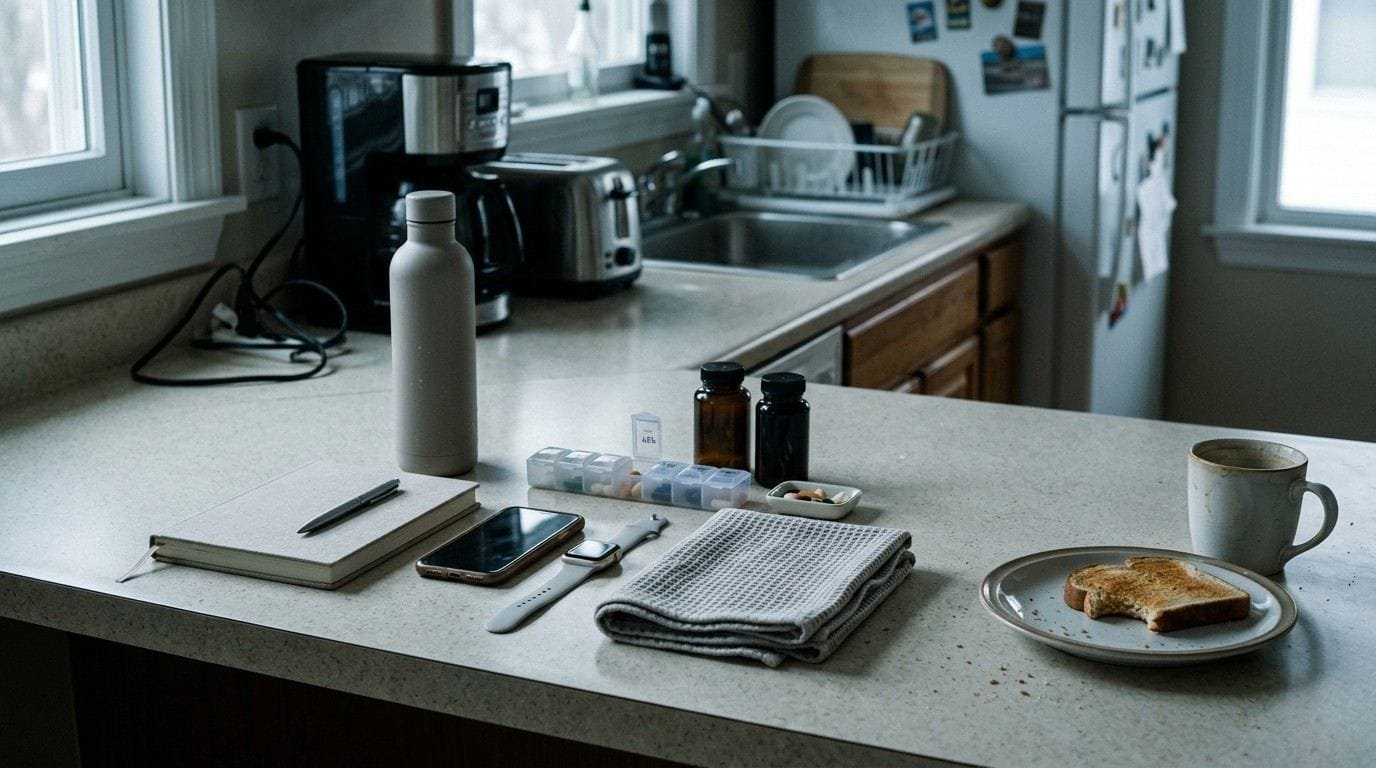
The result is performance anxiety about doing nothing. You lie still and wonder whether you’re recovering properly. You try to clear your mind, then become annoyed when thoughts keep arriving.
It is hard to relax inside an exam that never ends.
Perhaps the most useful thing to remember is that calm is not a test. A difficult afternoon doesn’t mean you have failed, and a high stress reading doesn’t tell the whole story of your day.
Calm Was Never a Flat Line
The popular picture of regulation is a flat line. Stress goes down, calm goes up, and a well-tuned person glides through the day without a ripple. It is a tidy image, and it is mostly wrong.
Our bodies are supposed to respond to changing demands. Your heart may race before a difficult meeting or when a car suddenly cuts across your path. You may feel alert, tense, or excited. These changes are not, by themselves, signs that your system has failed.
Nervous system regulation is less about avoiding heightened states than responding to them flexibly and settling when the situation allows. The aim is not to eliminate activation, but to move through it without remaining overwhelmed whenever possible.
Think about giving a presentation to forty colleagues. Feeling nervous beforehand would hardly be surprising. The more useful question is what happens after the presentation ends. Can you return to the rest of your day, or does the tension follow you long after the pressure has passed?
Even then, context matters. Someone dealing with grief, poor sleep, financial worries, or an unsafe environment may find it harder to settle. Their body may be responding to pressures that have not gone away. Better breathing alone cannot make those pressures disappear.
A daily score can flatten all this into a verdict. One number stands in for a whole day of rising and settling, inviting a pass-or-fail reading of something that was never meant to earn a grade.
A steady system is not one that never gets shaken. It is one that can respond to life and recover when circumstances allow.
The Tools Are Not the Problem
A sleep tracker can reveal patterns you might otherwise miss. A breathing exercise can bring real relief, and nervous system regulation practices can genuinely help in a hard stretch. Plenty of people use these tools lightly and benefit from them.
Measurement is not the villain, and neither is the habit of caring for the body. The trouble begins when a reading becomes more authoritative than the person it is supposed to help.
Someone wakes feeling rested, sees a poor score, and decides they must be more tired than they feel. The felt experience gets overruled by an estimate.
That reversal is easy to miss because it looks like diligence. Trusting the data feels rigorous, while trusting the body can seem vague. Yet the device is making an estimate from sensors and models. It cannot fully account for the demands of your day or the way you experienced the night.
There is also a cost that never appears on a dashboard. Every check pulls a little attention away from the moment at hand. Repeated often enough, the habit can teach us to doubt our own signals.
You might be sitting with a friend, walking through a park, or enjoying a quiet evening at home. Part of your attention keeps turning inward, asking whether you feel calm enough yet.
The tools were built to inform, and the practices were built to help. They become less useful when you treat them as the final word on how you feel.
A score can offer a clue. The trouble starts when it outranks every other clue, including the person who lived the experience.
The Question the Score Never Asks
Optimization has no natural stopping point. There is always a better score waiting just beyond the current one, which makes it a poor foundation for rest. A goal that cannot be completed is difficult to put down.
The backlash against over-optimization points to something real: nervous system regulation was meant to be relief. People are overloaded, and the wellness industry has noticed. What remains less clear is whether it can respond to that overload without turning relief into another standard to meet.
The same market that once sold intensity now sells calm, often to the same customers. A request for relief gets answered with a higher bar, and the bar may come with a subscription.
But there is a larger question here, beyond what the industry sells or what the latest device measures. What happens when you stop trusting your own experience unless a number confirms it?
Consider the moment before you check your phone in the morning. You may feel rested, tired, or somewhere in between. That feeling is not a complete medical assessment, and it does not need to be. It is simply one piece of information about how you are doing.
The score can add to that picture. It was never built to replace it.
Nervous system regulation can be useful without becoming another demand placed on an already crowded life. You are allowed to have difficult days, feel unsettled, and need time to recover.
The aim was never to become perfectly calm. It was to have enough room to live, feel, respond, and rest without turning every part of the experience into a problem to solve.